
Get in touch with Welong Company

Field-planning guide
A fishing operation in drilling is a planned response to downhole equipment, tubulars, wireline components, or debris that blocks the next intended well operation. Start the job with an evidence package, not a catalogue: establish what is downhole, what has changed since the incident, which facts are measured, and who can approve the next planning state. Only then can engineering review whether a retrieval, milling, bypass, or further diagnostic route is supportable.
This guide provides a 12-field fish profile, a six-link evidence chain, a role handoff, and four pre-run evidence gates. It deliberately does not reproduce the product families, engagement matrix, dimensions, or supplier-selection content owned by China Welong’s commercial Fishing & Milling Tools solution page.
Safety and authority boundary: the named structures below are editorial evidence aids. They are not an API requirement, job-safety analysis, well-control program, regulatory approval, operating procedure, or substitute for the well operator’s approved systems.
Key takeaway
Release a recovery-job recommendation only when the fish identity, interface geometry, operating context, and contingency evidence are traceable to an owner and approval state.
1. What a Fishing Operation in Drilling Actually Has to Resolve
A fishing operation is a planned response to equipment, tubulars, wireline components, or debris that prevents the next intended well operation. Its immediate objective may be recovery, removal, reshaping, or restoration of access; the objective is not automatically “bring everything to surface.” [1]
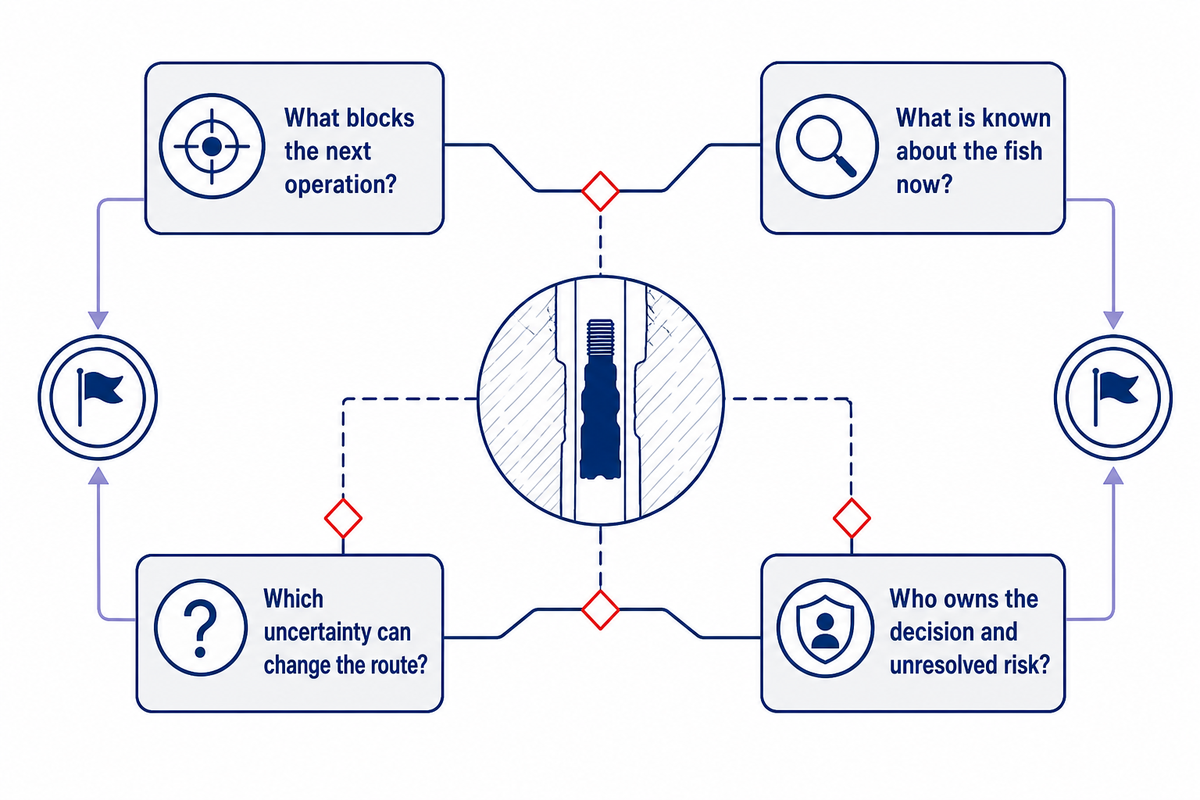
PETEX training material makes the core planning problem clear: each job has its own hole and fish conditions, so a method that worked in one well may not transfer to another. That is why a useful job brief answers four questions before it names a route: What blocks the next operation? What is known about the fish now? Which uncertainty can change the route? Who owns the decision and the unresolved risk? [2]
If the reader only needs what is fishing in drilling, common terminology, or a beginner overview, use this introductory explanation of fishing and milling. This article owns the separate job-planning intent: evidence capture, handoff, approval, reassessment, and procurement review.
Search language varies. Oilwell fishing, oil well fishing, well fishing, and special fishing can all point toward the same planning problem. Teams drilling wells may meet it during oil and gas exploration, gas drilling, drilling a new well, or later workover operations. Whether the asset is an oil or gas well, the brief must explain the need for fishing, what blocks the drilling process, and what must change for drilling to continue.
Within the oil and gas industry, including older oil industry and gas industry records, these labels do not alter the evidence standard. A new well does not make a missing fish identity safer to assume, and a workover does not make an unverified interface acceptable.
“Very little is routine about well site operations.”
U.S. Occupational Safety and Health Administration, Oil and Gas Well Drilling and Servicing eTool [3]
2. Build the 12-Field Fish-Profile Handoff Sheet
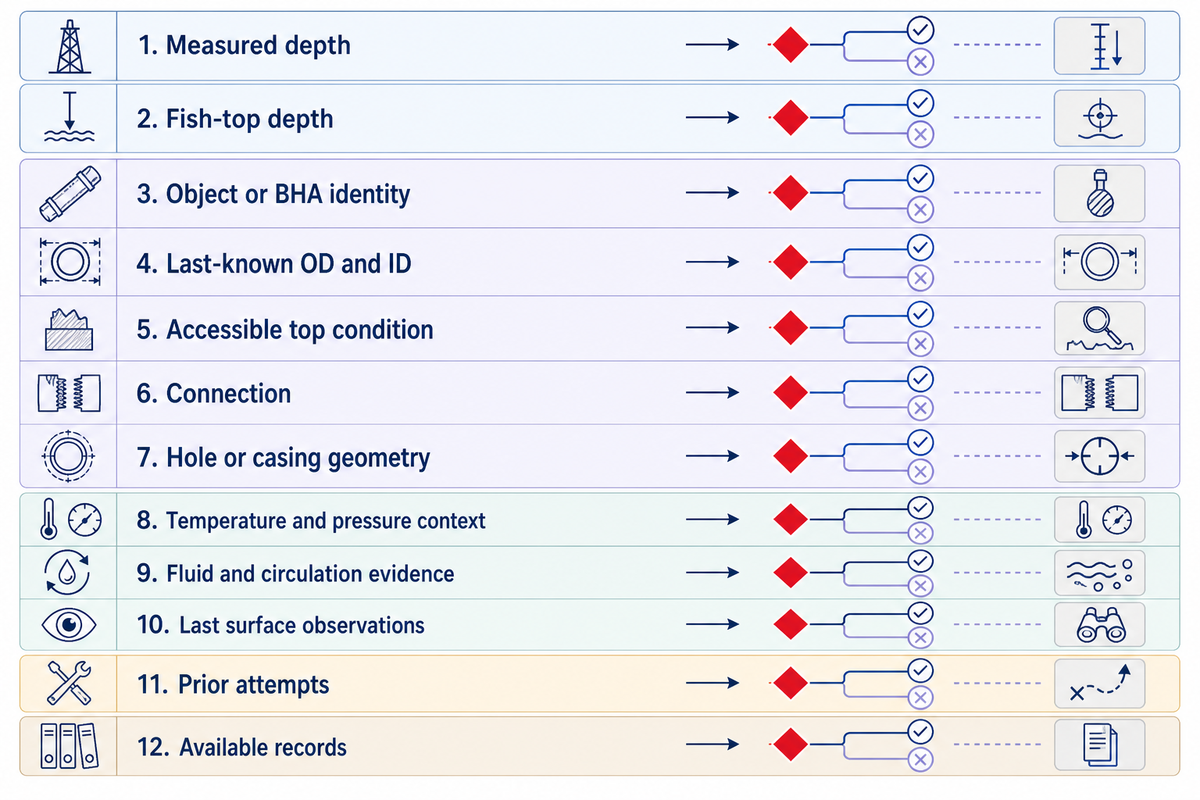
A fish profile is the record that travels from the rig to the people diagnosing, approving, sourcing, and verifying the job. Every entry needs a source, unit where relevant, confidence label, owner, timestamp, and verification state. Leave a blank cell marked unknown, because a visible unknown can trigger a hold; a guessed value can silently distort the interface review.
These fictional values show formatting only. They are not limits, recommendations, or evidence for a real well.
To identify the type of obstruction, record whether the event involves lost or stuck drill pipe, a stuck pipe interval, a drill bit, drill collars, wireline tools, or other drilling equipment. Distinguish a twist-off or parted drill string from a broken drill, lost equipment, lost tools, something dropped into the hole, equipment dropped into the well, or an object left in the wellbore. For an oilfield record, say whether each component is broken or lost; “lost in the hole” is not enough. Name the borehole context, last-known assembly, and evidence for the present condition.
Which inputs make a fish profile reviewable?
| Field | Example format (fictional) | Provenance and verification check |
|---|---|---|
| 1. Measured depth | 3,450 m MD; 3,120 m TVD | Survey reference, datum, timestamp, and owner |
| 2. Fish-top depth | 3,210 m MD; ±6 m confidence band | Method used to locate it and uncertainty interval |
| 3. Object or BHA identity | Reported drill-string component; identity unverified | Tally, serial record, assembly drawing, or recovered counterpart |
| 4. Last-known OD and ID | 127 mm OD; 76 mm ID | Drawing revision and whether deformation is expected |
| 5. Accessible top condition | Reported 15 mm lip deformation across a 40 mm contact zone; ±2 mm visual estimate | Separate direct observation from inference |
| 6. Connection | NC50 reported; gauge status unknown | Connection record, drawing, and model-specific gauge evidence |
| 7. Hole or casing geometry | 216 mm open hole above 244.5 mm casing; 190 mm logged restriction | Current restriction map, not nominal size alone |
| 8. Temperature and pressure context | 120 °C reported; 35 MPa modeled; record age 45 min | Timestamp, depth basis, operating state, and uncertainty |
| 9. Fluid and circulation evidence | 1,200 kg/m³ reported; circulation response incomplete after 20 min | Source log, sample time, returns, and loss observations |
| 10. Last surface observations | 12 MPa pressure change during an 8 min trend window; torque not reconciled | Raw trace, sensor source, event time, and interpretation owner |
| 11. Prior attempts | 2 runs over 6 hours; one changed the observed top condition | Assembly, sequence, response, recovered material, and disposition |
| 12. Available records | 3 drawings, 1 log set covering 90 min, 0 verified downhole images | File revision, custody, readability, and missing-record flags |
China Welong’s public intake already asks for fish type, casing or hole size, temperature, and connection. Those four groups are a practical start, but the expanded sheet is an editorial synthesis, not a China Welong field claim or an industry standard.
Fish-profile boundary: this is not the complete control system. Keep a separate, operator-controlled annex for live well-control and barrier status, formation and fluid conditions, simultaneous operations, control-system, alarm and emergency-shutdown readiness, step-specific hazard controls, and management-of-change status. OSHA’s oil and gas guidance treats these as whole-operation concerns rather than tool-selection details. [3]
This separation also answers a recurring field-language problem. Respondents in a public practitioner discussion about a stuck string quickly stalled because they did not have the BHA, depth, pressure context, well condition, or downhole restriction data. Although anecdotal, the exchange exposes a useful pain point: drilling fishing tools cannot compensate for a missing incident record.
3. Trace the 6-Link Recovery Evidence Chain
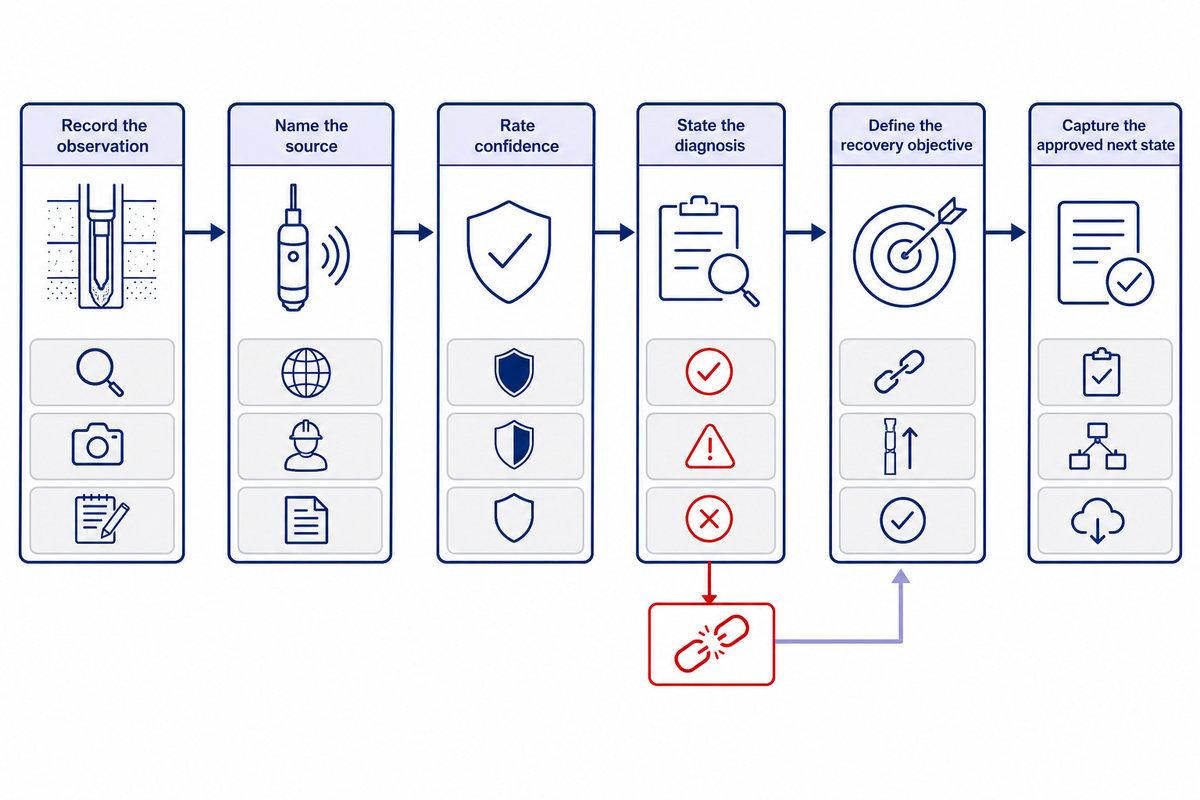
Raw data does not become a decision merely because it appears in a report. This 6-Link Recovery Evidence Chain keeps the observation, its provenance, the interpretation, and the approval separate. That separation matters when two measurements support different diagnoses or when a previous fishing job has already changed the object.
Clear evidence also keeps search vocabulary from becoming a recommendation. Common fishing tools, fishing equipment, special tools, and specialized equipment are broad labels. A downhole tool or drilling tool may be used to retrieve an object or collect evidence, but conditions that require special tools still do not identify the proper fishing tool. Even a search typo such as overshoot should be checked against the intended model term rather than copied into an inquiry. A fishing expert can review tools and techniques only after the job record establishes the interface and objective.
How does raw evidence become an approved next state?
- Record the observation — preserve the actual trace, image, recovered material, mark, or report without rewriting it as a diagnosis.
- Name the source — identify the instrument, document, person, time, unit, and revision that produced the record.
- Rate confidence — classify the input as measured, reported, inferred, or unknown and explain the uncertainty.
- State the diagnosis — show which observations support it and which observations could contradict it.
- Define the recovery objective — specify the next well objective that must become possible, not just the preferred tool action.
- Capture the approved next state — record continue, hold, obtain more evidence, change route, or close out with the named authority.
One BSEE-hosted technical assessment illustrates why the links must stay separate. In a documented case, a recovery attempt failed, tools were pushed into the tailpipe, and work later stopped because the obstruction no longer prevented the intended objective. “Fish recovered” would have been the wrong success test; the changed well objective drove the close-out decision. [4]
| Evidence type | What it can establish | Common failure risk | Verification owner |
|---|---|---|---|
| Tally and assembly records | Last-known identity and sequence | Revision or transfer error | Drilling records owner |
| OEM or supplier drawings | Nominal interfaces and model details | Wrong revision or variant | Supplier engineering |
| Survey and wellbore records | Depth, geometry, and restrictions | Datum or current-state mismatch | Well engineering |
| Surface traces and logs | Time-based torque, pressure, or drag response | Multiple plausible interpretations | Data owner and fishing engineer |
| Impression or diagnostic evidence | Accessible shape or contact condition | Poor transfer or overinterpretation | Fishing engineer |
| Recovered material | Observed material, fracture, or wear | Lost chain of custody | Wellsite and quality teams |
| Returns and debris record | Material and circulation observations | Mixed or unrepresentative sample | Wellsite team |
| Photos and inspection reports | Before-and-after condition | No scale, time, or orientation | Inspection or quality owner |
| Prior-run report | Assembly, response, changed assumptions, and disposition | Summary omits raw evidence | Job supervisor |
These nine categories are not ranked by authority. Current, well-scoped measurements may outweigh a generic manual, while a supplier drawing may be decisive for one interface and irrelevant to the present fish shape. Use the matrix as a filing and review aid, not a tool-selection rule.
4. Record Why a Recovery Route Changes
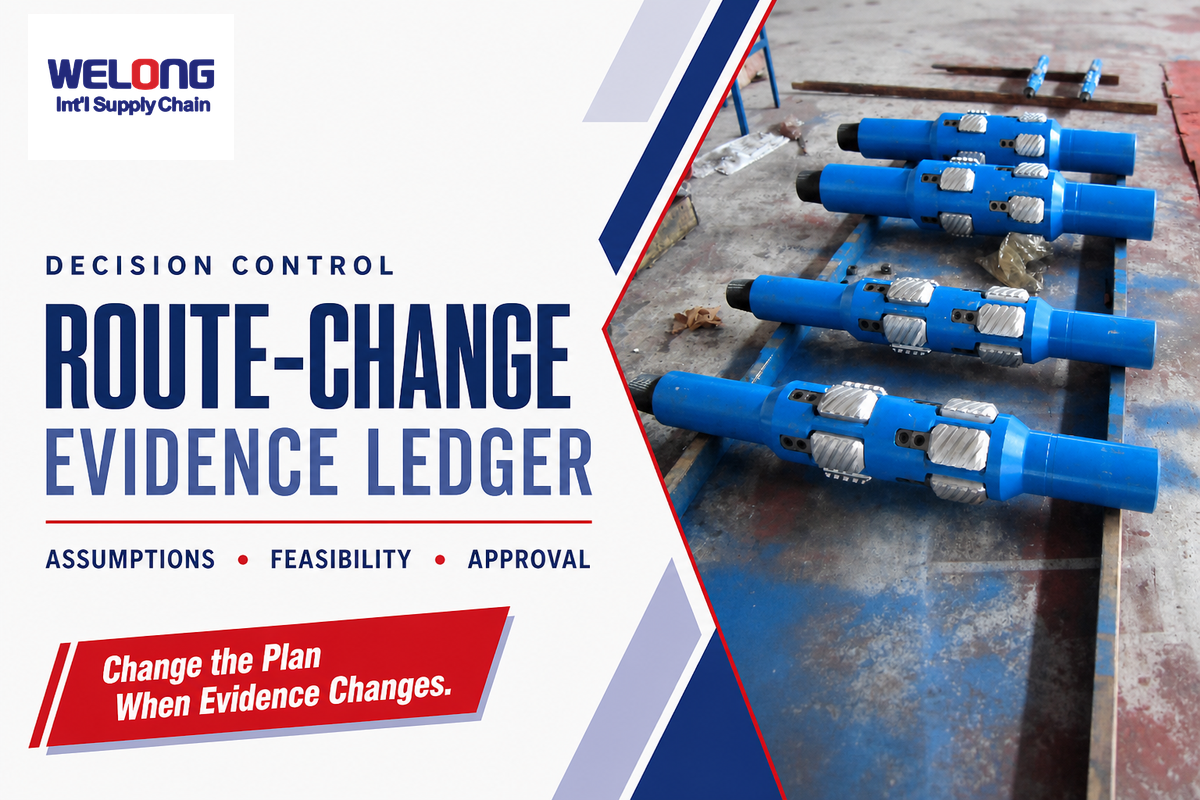
A team should change the planning state when new evidence alters an assumption, a feasibility boundary, the consequence of failure, the approved objective, or the safety basis. “We have already tried twice” is history, not a decision rule. Ask what the two attempts taught and whether the next action responds to that evidence.
The cost of fishing and probability of success belong in that record, but universal rules of thumb do not. Different fishing methods can change access, evidence quality, and consequence; a proposal to bypass the fish changes the objective rather than proving recovery impossible. Certain types of fishing may preserve more evidence than others, so keep facts about the fish and fishing attempt separate from the route preference.
What should trigger a route-change review?
| Current state | New evidence or trigger | Decision effect | Permitted next planning state |
|---|---|---|---|
| Identity reported | Drawing revision does not match the tally | Interface assumptions become unverified | Hold and reconcile records |
| Fish top at 3,210 m | Second locating source disagrees by 18 m | Depth confidence falls | Request independent verification |
| 127 mm OD assumed | Impression evidence suggests deformation | Nominal geometry no longer proves access | Rebuild the geometry case |
| 76 mm ID reported | Connection record identifies a different variant | Internal interface is uncertain | Hold supplier review |
| 35 MPa context modeled | Current well state differs from the model basis | Operating-context evidence expires | Return to operator review |
| Circulation expected | Returns do not match the expected response | Debris and access assumptions weaken | Stop and reassess evidence |
| Recovery is the objective | Fish no longer blocks the next well objective | Benefit of further recovery changes | Evaluate close-out or alternate plan |
| Procedure unchanged | Job scope or condition changes | Existing hazard analysis may no longer apply | Stop, communicate, and assess change control |
| Supplier data accepted | Certificate or model scope cannot be verified | Compliance claim is insufficient | Request current scoped evidence |
| Next run proposed | Approver or stop-work authority is not named | Governance handoff is incomplete | Hold until authority is mapped |
A 2023 Gachsaran study did not apply a universal fishing-time percentage. It built a field-specific economic model from 62 fishing operations, 56 sidetracking operations, depth, rig cost rate, and interviews, and noted that the field had no pre-existing rule for optimum fishing duration. This supports a job-specific calculation; it does not establish a portable cutoff. [5]
5. Separate the Six Handoff Roles From Legal Authority
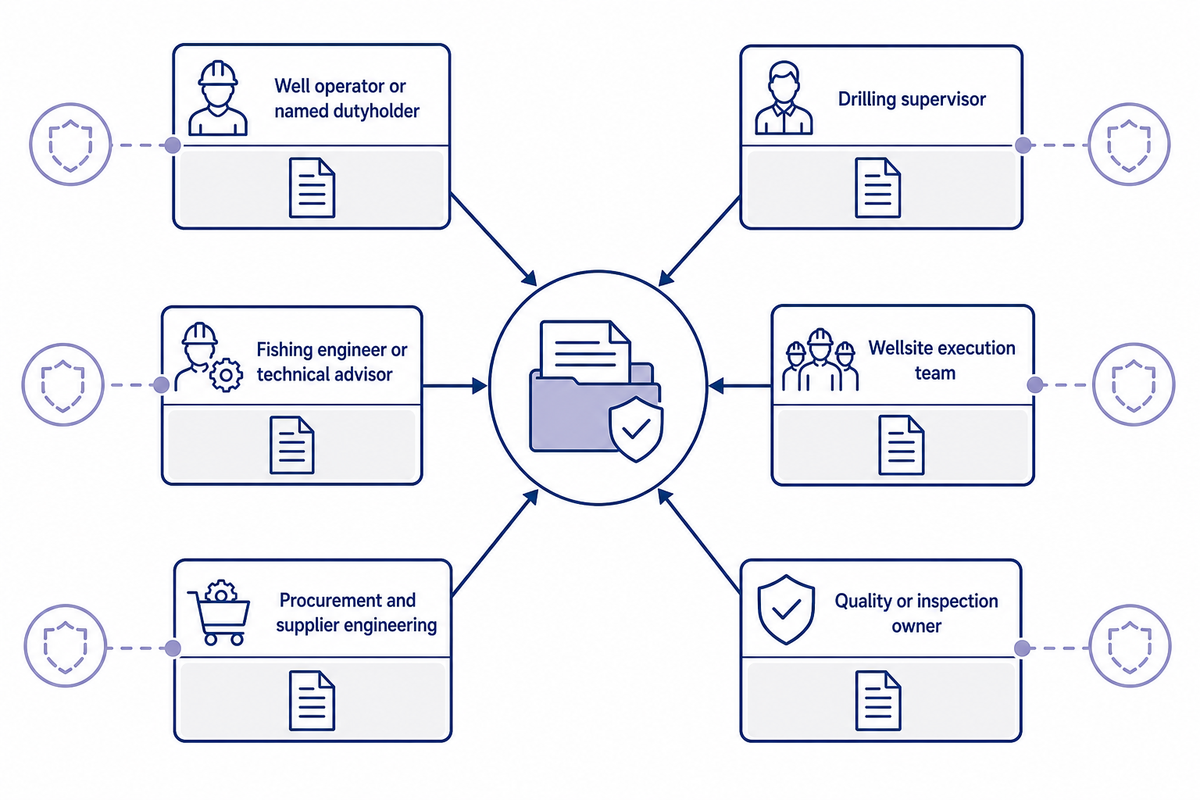
Use a role table to prevent dropped evidence, not to reassign statutory duties. A fishing supervisor may plan with the customer, direct service execution, and report equipment use. That does not automatically make the service company the well operator, approval owner, incident-reporting party, or legal dutyholder.
For example, UK HSE Operations Notice 30 states that, in its UK offshore reporting context, a well operation remains under the control of a well operator and that the well operator reports a dangerous occurrence at the well when different from the installation operator. Other jurisdictions and contracts can use different role names and duties. Each project must map its own authority rather than copy the six labels below. [6]
| Generic role | Primary evidence contribution | Verification output | Authority boundary to state |
|---|---|---|---|
| Well operator or named dutyholder | Objective, well state, barriers, governing program | Approved scope and control basis | Retained control, approvals, reporting, and change governance as applicable |
| Drilling supervisor | Event timeline, rig observations, current constraints | Reconciled operational record | Site authority and stop-work route under the operator’s system |
| Fishing engineer or technical advisor | Diagnosis, uncertainty, evidence needs, proposed route | Technical recommendation with assumptions | Advice is not final operator approval |
| Wellsite execution team | Assembly checks, observations, returns, recovered condition | Timestamped run record | Execution follows approved procedure and stop-work rules |
| Procurement and supplier engineering | Model data, drawings, availability, inspection documents | Commercial and technical review package | Supply confirmation does not prove well suitability |
| Quality or inspection owner | Identity, traceability, inspection, certificate scope | Acceptance or discrepancy record | Document acceptance does not replace operational approval |
For every row, add the named person or organization, jurisdiction and contract basis, due point, approval output, stop-work authority, and legal-reporting owner. An unassigned cell is a project risk; filling it with the nearest job title is not verification.
6. Run the 4-Gate Pre-Run Evidence Review
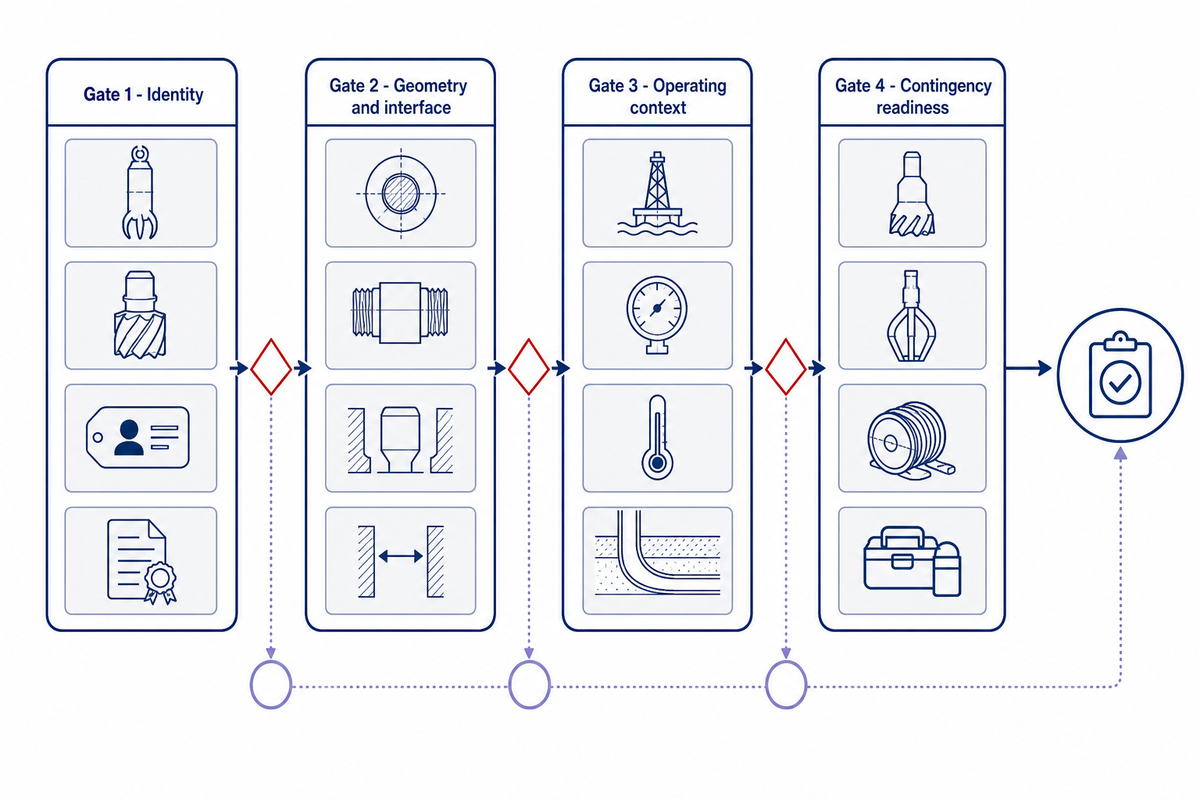
The 4-Gate Pre-Run Evidence Review produces an evidence recommendation of go, hold, or escalate covering identity, geometry and interface, operating context, and contingency readiness. It is subordinate to the operator’s hazard analysis, well-control, regulatory, and approval systems.
- Gate 1 — Identity — reconcile the fish, assembly history, top condition, prior attempts, and any variant or revision conflict.
- Gate 2 — Geometry and interface — verify current restrictions, accessible surfaces, connection data, conveyance path, and model-specific drawing or gauge evidence.
- Gate 3 — Operating context — confirm the current well state, drilling fluid and circulation evidence, temperature and pressure basis, barrier status, simultaneous operations, and step-specific hazard review.
- Gate 4 — Contingency readiness — define observable response, hold points, stop-work triggers, evidence capture, alternate planning states, change-control route, and approval owner.
An impression block or another diagnostic record can support the geometry review only within its stated quality and interpretation limits. It does not erase conflicting dimensions, prove the present load path, or release the next run on its own.
Do
- Bind every value to a unit, source, revision, and verification state.
- Use model-specific drawings and limits only for the identified model.
- Keep safety, well-control, and regulatory approval outside the editorial gate score.
- Record the evidence required to move from hold to review.
Don’t
- Convert a nominal dimension into a clearance conclusion.
- Treat an API or ISO label as proof of complete job suitability.
- Turn a supplier’s availability statement into operator approval.
- Release a recommendation while authority or change control is unresolved.
API scope is a useful check on overclaiming. In its official catalog, API describes Specification 7-1 as covering technical delivery conditions for named rotary drill-stem elements, while Specification 7-2 covers threading and gauging of rotary shouldered connections. API’s current update page lists a 7-1 Second Edition addendum in March 2025, a second erratum in November 2025, and a Kelly-valve transition notice in April 2026. None of those entries turns “API 7-1” into a universal fishing-job approval. [7][8]
Supplier credentials need the same scope discipline. China Welong states that it is certified to ISO 9001:2015 and API Spec 7-1. ISO describes ISO 9001:2015 as a quality-management-system standard, so it can support a supplier-system review but cannot prove that a specific assembly suits a specific fish. For a reported NC50 interface, an ISO/TC 67 standards map lists ISO 10424-2:2007 under threading and gauging of rotary shouldered thread connections. Confirm the current ISO edition or status, the certificate scope, and model-level applicability rather than treating any label as job approval. [13][14]
Where a proposal contains a number such as 120 °C, 35 MPa, 127 mm, or 3,210 m, the gate checks provenance and scope; it does not validate the number simply because the unit is present. That distinction keeps the worksheet useful without turning it into remote operating advice.
7. During the Run, Update Evidence, Stop, and Reassess
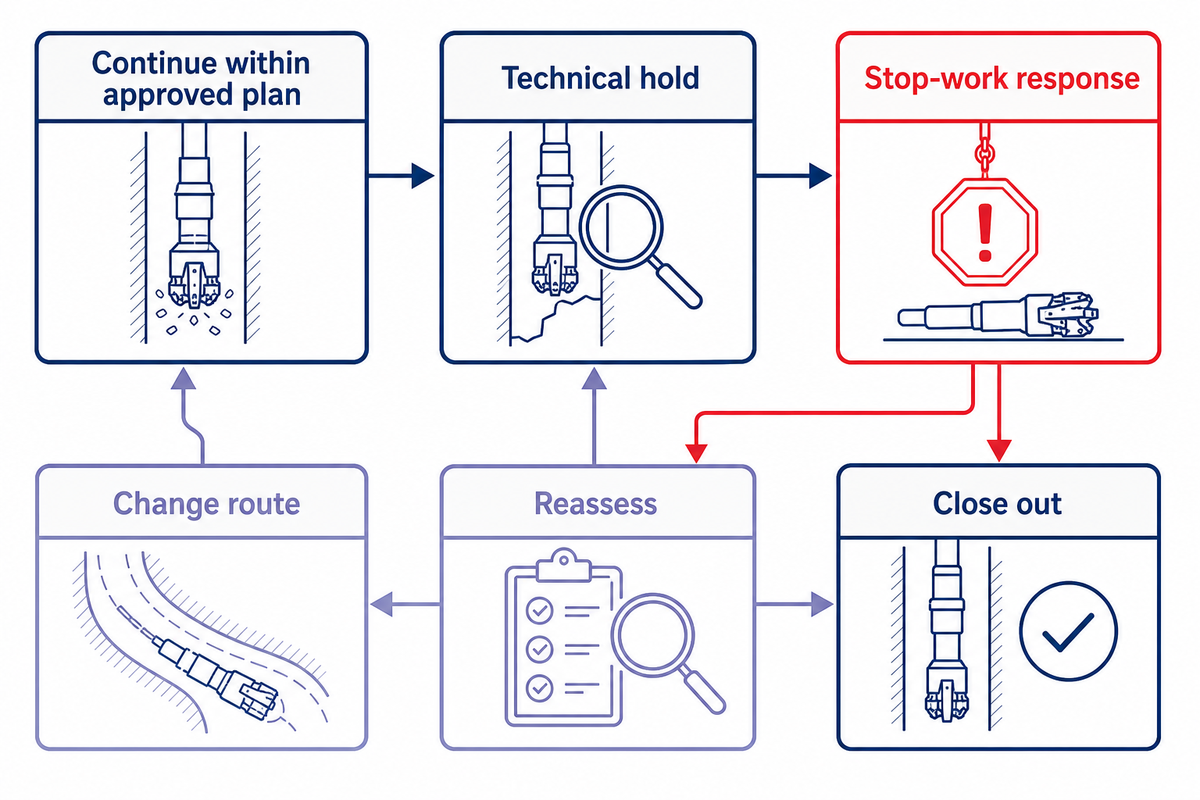
During execution, the job record should distinguish an expected observation, a deviation, a safety trigger, a technical hold point, and a changed objective. Record what was observed, when, by which source, what it does to the working hypothesis, and who sets the next state. Do not wait until the end-of-tour summary to reconstruct the sequence.
| State | Minimum record | Decision boundary |
|---|---|---|
| Continue within approved plan | Expected observation, timestamp, source, and no conflicting trigger | Only within the approved procedure and authority |
| Technical hold | Missing or contradictory evidence and the question it blocks | No inferred value may clear the hold |
| Stop-work response | Changed condition or safety concern and immediate communication record | Operator procedures and stop-work authority govern |
| Reassess | Updated hazard analysis, contractor coordination, assumptions, and management-of-change status | Recovery economics cannot override the safety trigger |
| Change route | New evidence, affected assumption, consequence, proposed state, and approval | The revised route needs its own evidence and control basis |
| Close out | Objective status, residual obstruction or risk, records, and acceptance owner | “Not recovered” can still require a formal disposition |
How much time should we spend trying to recover the fish?
There is no defensible universal time or cost percentage. A decision depends on evidence gained per attempt, expected recovery value, remaining technical feasibility, risk, rig and service cost, and the value and feasibility of alternatives such as a sidetrack. In the Gachsaran study, 62 fishing and 56 sidetracking operations supported a local model; that dataset does not become a rule for another field. [5]
Fishing cost can dominate a specific incident without defining an industry benchmark. A 2025 Changuleh case-study paper reproduces figures from a cited 2017 Azar conference paper: fishing accounted for 45%, 47%, and 41% of idle or non-productive drilling time in three named wells. This is secondary reporting of field-specific figures, not a universal benchmark. The percentages show why an evidence-based reassessment matters; they do not justify a 45% cutoff elsewhere. [9]
OSHA adds a separate decision layer: when conditions or scope change, contractors should stop, address and communicate new hazards, reassess risk, and use management of change where needed. That obligation can arise even when the fish remains technically recoverable and the economic case still looks favorable. [3]
8. Preserve Post-Run Evidence for the Next Trip
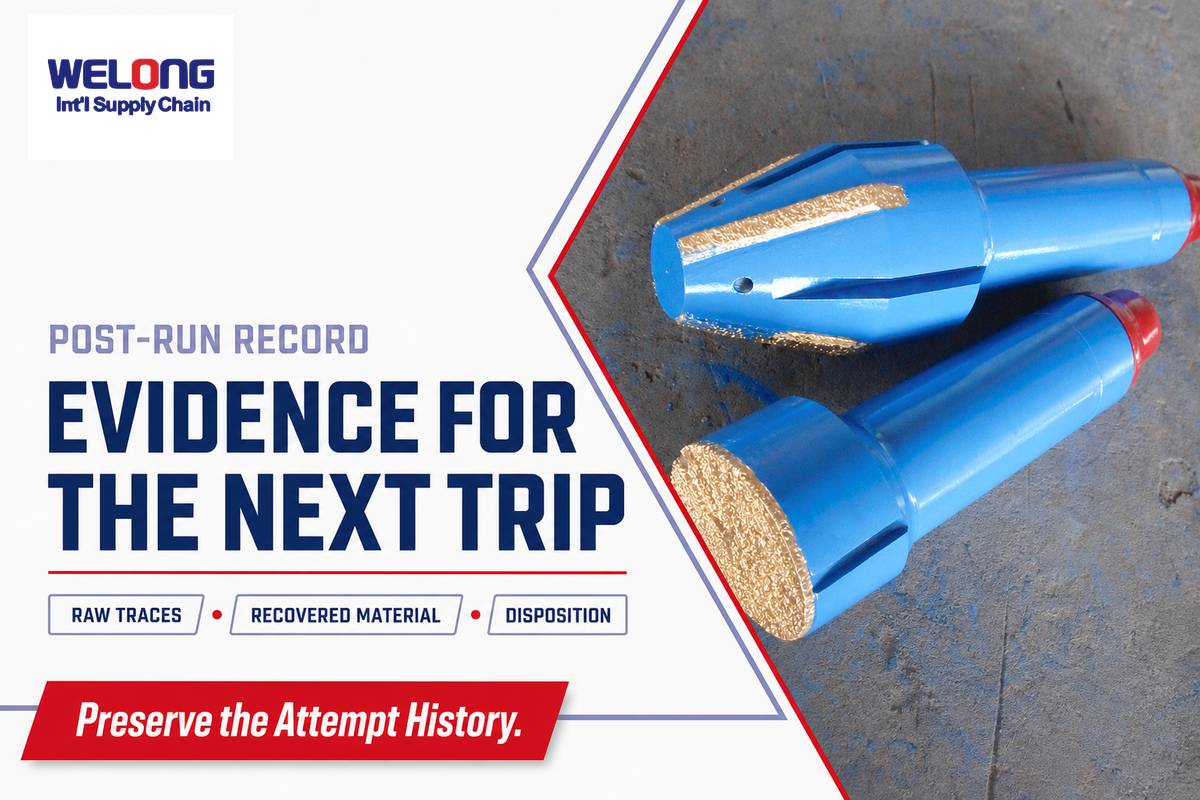
A post-run record should make the next review faster and more accurate. Preserve the assembly run, surface traces, recovered material, witness marks, tool condition, circulated debris, photographs with scale and orientation, unexpected behavior, and every assumption that changed. Label observations separately from inferred mechanisms.
| Record | Before run | After run | Next-decision use |
|---|---|---|---|
| Objective | Approved and scoped | Met, partly met, or not met | Defines whether further work is needed |
| Assembly identity | Drawing and tally verified | Returned assembly reconciled | Confirms what actually went downhole |
| Surface response | Expected signature recorded | Raw trace and deviations saved | Tests the working diagnosis |
| Recovered material | Expected material noted | Tagged, photographed, and retained | Supports identity and mechanism review |
| Witness marks | Reference condition photographed | Scale and orientation added | Shows contact without guessing cause |
| Returns or debris | Sampling plan agreed | Source and custody recorded | Supports material and hole-cleaning review |
| Unknowns | Visible in the job brief | Resolved, unchanged, or newly created | Sets the next evidence request |
| Disposition | Decision owner named | Continue, hold, change, or close approved | Prevents the next shift from restarting the diagnosis |
A published SLB case shows the value of preserving a long attempt history. After two unsuccessful campaigns, the team reviewed the event sequence and dimensions, produced a detailed proposal, and obtained operator approval. The case reports recovery of 11,575 ft (about 3,528 m) in 21 wire fishing runs; after 26 total runs, the well was confirmed clear of wire. Its takeaway is not that either run count is normal; prior attempts, approval, and run-by-run evidence remained part of the engineering record. [10]
Current digital signals point in the same direction. An SLB page dated April 10, 2025 describes integrated planning, automated validation, real-time analytics, and a shared data source from planning into operations. A patent published May 21, 2025 describes sensor-based milling displacement and condition detection. These are workflow and innovation signals, not proof that a particular platform or patented method will work on a given fish. [11][12]
9. Build the Engineering and Procurement Review Package
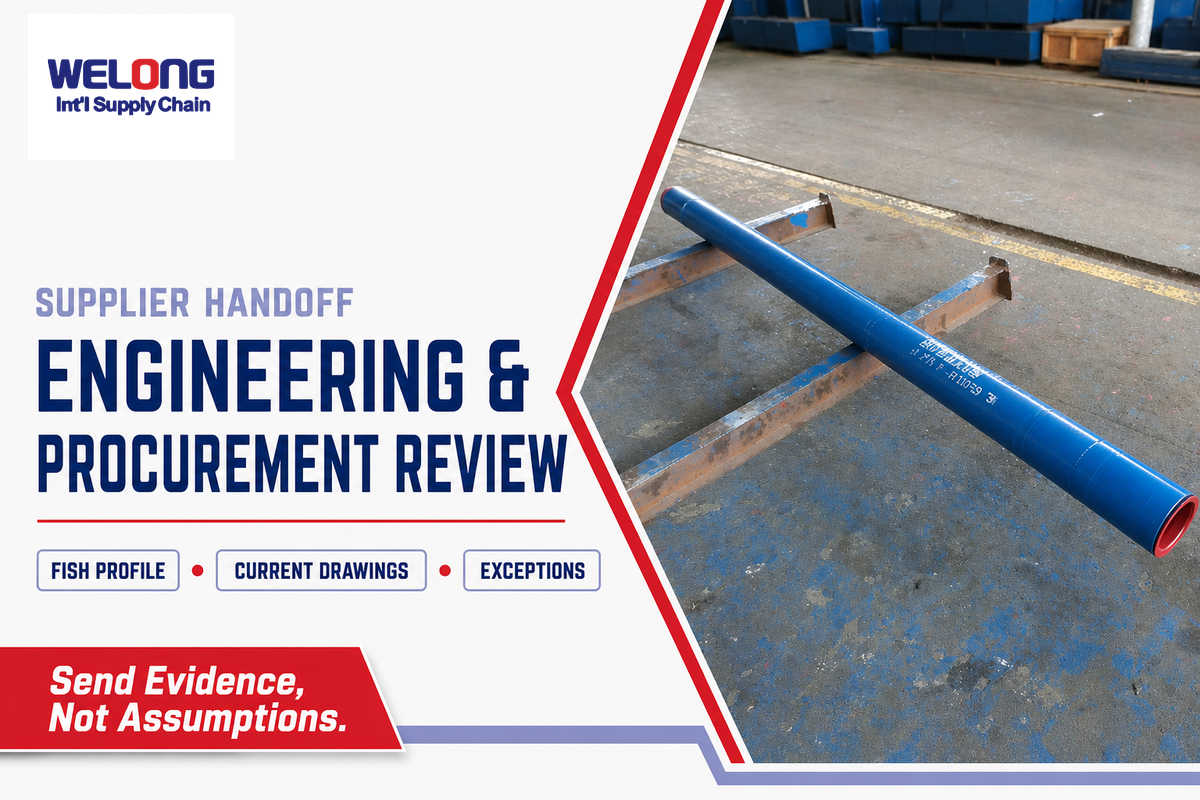
A buyer should not send only “need fishing tool” and expect a defensible match. Send the verified fish profile, operation-control boundary, evidence chain, prior-run record, unresolved unknowns, requested review scope, delivery constraints, inspection documents, and acceptance criteria. Suppliers can then state what they can review, what remains conditional, and which model-specific documents are required.
You can copy this table into the technical portion of an inquiry. “No default” means the value must come from the job record; it is not an invitation to insert a catalogue number.
What belongs in the supplier review package?
RFQ checklist — copy these into your quote request:
| Parameter | Recommended range | Why it matters | How to verify |
|---|---|---|---|
| Fish identity and top condition | No default; measured, reported, inferred, or unknown | Defines the review basis | Tally, impression, photo, or diagnostic record |
| Depth and datum | No default; enter the current value in m or ft | Prevents datum and access errors | Current survey and event timeline |
| OD, ID, and accessible geometry | No default; enter values in mm or in | Supports interface review | Current drawing plus deformation evidence |
| Hole, casing, and restrictions | No default; map each restriction in mm or in | Supports conveyance and clearance review | Well schematic and restriction log |
| Connection and assembly | Exact designation and drawing revision | Prevents variant mismatch | Gauge record, tally, and model document |
| Temperature and pressure context | Job-specific °C and MPa with time and state | Defines the stated environment | Operator-approved current data |
| Prior attempts and evidence | All runs; do not send only the latest summary | Shows changed fish and access conditions | Run sheets, raw traces, photos, and recovered material record |
| Inspection and acceptance package | Project-specific certificates, reports, and hold points | Defines delivery evidence | Current scope, edition, issuer, model, and acceptance owner |
If you need examples of the model-level data that should accompany the package, review the public pages for die collar connection and dimensional data, junk and taper mill size data, and fishing jar operating data. The broader downhole drilling tools overview can help route an inquiry that extends beyond fishing and milling. These examples show what must be checked; they do not establish fit for an unreviewed job.
China Welong can use the completed evidence package to review available fishing and milling tool families against the stated inquiry. Ask for current drawings, inspection evidence, certificate scope, and exceptions before treating the review as complete.
Send the verified job package for review
10. Frequently Asked Questions
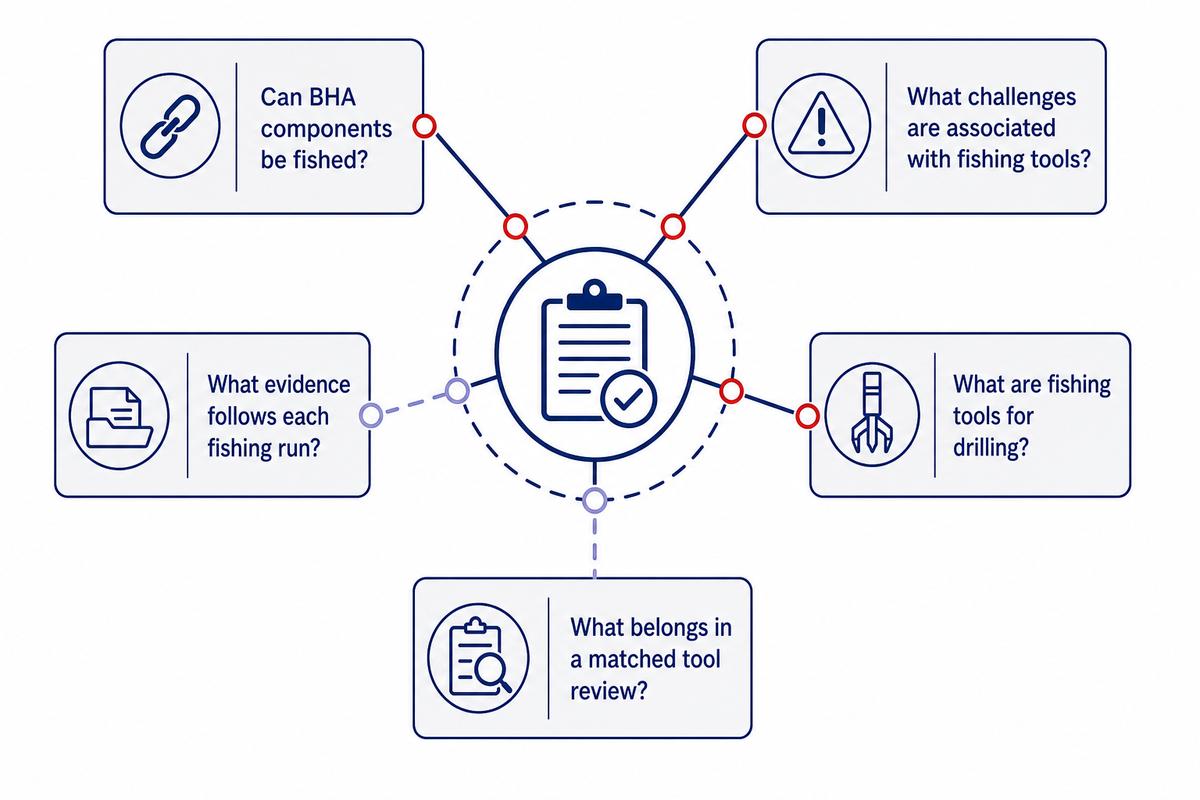
Can BHA components be fished?
Many BHA components can be recovered, but recoverability depends on current condition, location, accessible geometry, connection state, and whether the assembly is free or mechanically stuck. First verify what remains downhole and which surfaces can be reached. A proposed route is then reviewed against the wellbore, conveyance path, load path, current well state, and model-specific limits. A component name alone can’t predict a successful fishing job.
What challenges are associated with using fishing tools for drilling?
Uncertainty is the main challenge. Recorded identity may differ from the present shape, the top can be damaged, dimensions may be incomplete, and earlier attempts may have changed access or packed debris around the object. Surface torque or pressure can also support more than one diagnosis. A defensible plan records the source and confidence of each input, keeps unknowns visible, and requires reassessment when new evidence contradicts the working hypothesis.
What are fishing tools for drilling?
Fishing tools used in oil well operations help identify, engage, release, reshape, remove, or bypass equipment and debris that prevents the next well activity. Functional groups include diagnostic, external-catch, internal-catch, impact, washover, cutting, milling, and debris-control tools. This guide uses the types of fishing tools in drilling only to explain planning inputs; the linked solution page owns product families, dimensions, and sourcing options.
What evidence should be recorded after each fishing run?
Record the assembly, raw response, recovered material, witness marks, debris, changed assumptions, and approved next state. Keep observation separate from diagnosis.
What information should be sent before a matched tool review?
Send the completed 12-field fish profile, current well and restriction context, exact connection, current drawings, prior-attempt history, raw traces, photographs or inspection records, recovered-material notes, missing-data flags, requested engineering scope, delivery constraints, and acceptance evidence. Identify which values are measured, reported, inferred, or unknown; state the unit, revision, owner, timestamp, and confidence for each critical input. Also name the operator approval owner, stop-work route, legal-reporting owner where applicable, and every unresolved management-of-change item. China Welong’s product page begins with fish type, casing or hole size, temperature, and connection, but those four groups belong inside the fuller evidence package. Ask the supplier to list assumptions and exceptions rather than silently filling gaps.
References & Sources
- PETEX, The University of Texas at Austin — Special Drilling Operations preview.
- PETEX, The University of Texas at Austin — Open-Hole Fishing preview.
- U.S. OSHA — Oil and Gas Well Drilling and Servicing: Safety and Health Program.
- U.S. Bureau of Safety and Environmental Enforcement — Coiled Tubing Technical Assessment.
- Iranian Journal of Oil & Gas Science and Technology — Gachsaran fishing-time optimization study (2023).
- UK Health and Safety Executive — Operations Notice 30.
- American Petroleum Institute — 2025 Exploration and Production catalog.
- American Petroleum Institute — Monogram and APIQR latest updates.
- 2025 Changuleh case-study paper in PubMed Central; its Azar percentages are explicitly attributed to a cited 2017 conference paper.
- SLB — Heavy-duty fishing case study, North Sea.
- SLB — Integrated and automated drilling workflow page (2025).
- European patent publication EP4555190A1 — sensor-based milling displacement and control.
- ISO/TC 176 — ISO 9001:2015, Quality management systems — Requirements.
- ISO/TC 67 — Global standards used locally worldwide (2024 standards map).
Method note: field values labeled fictional illustrate the structure of an evidence record only. Case numbers remain scoped to their named sources. Product-page statements are treated as first-party supplier information, and every named framework in this article is an editorial synthesis rather than a standard or operating procedure.
![Casing, Tubing & Drill Pipe Elevators [Field Guide]](https://welongoiltools.com/wp-content/uploads/2026/09/casing-tubing-drill-pipe-elevators-guide-featured-768x512.png)
![Choke & Kill Hose: [Field Guide]](https://welongoiltools.com/wp-content/uploads/2026/07/choke-kill-hose-guide-featured-1-150x150.png)